


Pionierand
Engineerseries
|
The Pionier
series of radio kits predate all related
electronics kits from Philips. They were made in the late fifties, and
probably into the early sixties. The larger senior
series are
based on vacuum tubes, and the assembly requires soldering. The smaller
junior
series on the other hand is based on early germanium
transistors (OC 13 and OC 14, apparently OC 71 and OC 72s that failed
quality control!) and components are mounted with a nut and bolt system.
This seems to be the ultimate ancestor of the EE kits, as well as the
later radio kits, which were also influenced by the development in the
EE kits.
| |||
|
|
| |
|
|
|
|
The Pionier junior
series developed in stages:
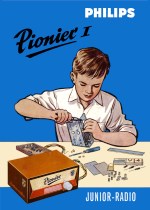
In 1957, it consisted only of a single two-transistor and crystal earphone kit simply called Pionier with the tagline Junior transistor-radio
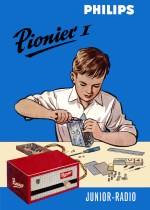
In 1958, this was renamed Pionier II when a smaller diode receiver kit Pionier I with the tagline Junior-radio and an intermediate expansion Pionier I A was added
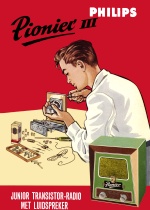
The expansion Pionier II A containing a third transistor, a loudspeaker and a larger box might have been added at the same time or later that year. The resulting Pionier III was never made available as a separate kit, but the expansion contained a manual with this title and the tagline Junior transistor-radio met luidspreker (Junior transistor-radio with loudspeaker)
Later, the box design of the smaller radios were changed, and the logo on the Pionier II was brought in line with its siblings. The instruction books went through several revisions, where the most material changes consisted in adding circuit variants. More of those were collected in a final expansion book, Uitbreidingen Pionier III.
Such variants include:
Both the revised manuals and the Pionier III Uitbreidingen describes how to use the PP 11 universal coil as an alternative or supplement to the self-wound ferrite rod coil.
The Pionier III manual describes how to use a 918/08 transformer in order to use normal low impedance loudspeakers instead of the included 150 Ω one.
That manual also describes how to add another amplification stage using a fourth transistor, three more capacitors and five more resistors, which had to be bought separately. While it was shown how to mount these with the help of a 5-pole terminal strip in the original manual, the revised manual claimed that the kit contained extra screws an threaded bushings for this purpose. This is not reflected in the component count at the end however, despite other updates being made to this.
The revised Pionier III manual also mentions that a Wooden cabinet is available as a more durable replacement for the included cardboard one.
For two of the variants described in Pionier III Uitbreidingen, the necessary components were sold as packets with type numbers 122.060 and 122.161.
I have only seen this series in Dutch.
The Engineer series was very short-lived; the absence of Philips branding indicates that this might have been made as a market test. I have only seen Finnish material about these kits, but it was presumably translated into several languages. Ilustrations from the Pionier series material was reused or redrawn, some details are Pionier-specific where the two differ.
Overall, the series differs little from the Pioner series. It uses OC 75 and OC 72 transistors instead of OC 13 and OC 14, and the huge external coil antenna also used in the EE 10 series instead of the ferrite core coil used both in the Pionier kit and later EE kits.
The Senior series was contemporary with the Junior series, and used many of the same components. The major differences were:
It employs vacuum tubes rather than transistors.
It uses mains power rather than batteries.
It is assembed by soldering rather than with threaded fasteners.
 |
 |
 |
 |
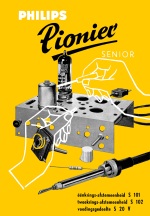
Pionier S 101 – Single stage receiver
Pionier S 101 A – Expansion from S 101 to S 102 (two stage receiver)
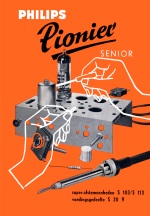
Pionier S 102 A – Expansion from S 102 to S 103 (super
receiver)
Pionier S 113 – Super
receiver
Pionier S 20 V – Power supply for any of the receivers
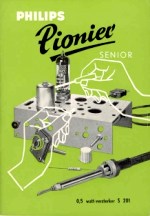
Pionier S 201 – ½ W amplifier for any of the receivers
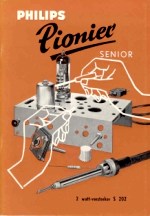
Pionier S 202 – 2 W amplifier for any of the receivers
There were no S 102 or S 103 kits, one had to buy S 101 and the expansion(s) for these constructions. S 113 is a slightly improved version of S 103 suggested if the radio is not built stage by stage.
Like the Junior series, it seems to have been available in Dutch only. The Junior/senior pairing combined with a shared mechanical construction makes it likely that they either were conceived of more or less simultaneously, or that one inspired the creation of the other. That the logo on the Senior series instruction books is identical to that on all but the earliest Junior series book might indicate that the originally unnumbered Junior kit appeared first.
 |
back | Tor Gjerde <i@old.no> |